
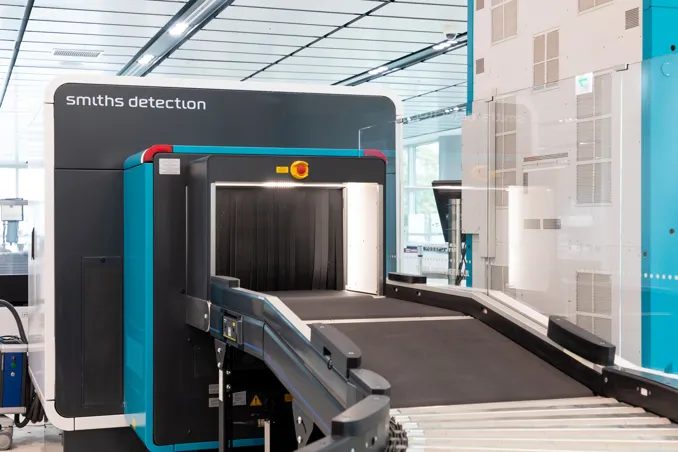
Good news for anyone who has ever juggled a plastic bag, a laptop and a pair of boots while going through airport security. Heathrow has changed the rules and your next departure should be significantly less stressful.
For most travellers the key change is simple: liquids can stay in your bag. No plastic bag required unless needed at a different airport on your journey, no removing your laptop, no 100ml limit. Heathrow is now the largest airport in the world to have fully rolled out the new generation of CT security scanners across all four terminals. Here is what has changed and what still applies.
What has changed
- Liquids in containers up to 2 litres can stay in your cabin bag. The 100ml limit is gone at Heathrow.
- No more plastic bags at security. You do not need to bag your liquids or remove them from your luggage.
- Laptops and large electronics stay in your bag. No need to remove them and place them in a separate tray.
- The change applies at all four terminals: T2, T3, T4 and T5.
- An estimated 16 million fewer plastic bags will be used each year as a result.
What still applies
The new CT scanners do not change everything. These rules remain in place:
- Coats must come off and go in the tray.
- Belts with buckles must be removed before walking through the metal detector arch.
- Pockets must be emptied. Coins, keys, phones and small items go in the tray.
- Refillable metal or double-walled containers such as vacuum flasks and insulated cups must be emptied before security. They can be refilled once you are through.
- Shoes do not routinely need to be removed but security staff may ask, particularly for boots or thick-soled footwear. Be prepared just in case.
- Electronic devices must be charged and able to switch on. If a device cannot be powered up when asked, you may not be allowed to take it on board.
- Food and powders should go in hold luggage where possible. They are permitted in hand luggage but can still trigger additional checks as they can obscure x-ray images. Allow extra time if you need to carry them in your cabin bag.
Batteries and power banks
This is where many travellers get caught out. The rules on batteries are strict and apply regardless of the new CT scanners.
- Phones, laptops, tablets and other devices with built-in batteries can go in either hand or hold luggage.
- Power banks and spare loose batteries up to 100 watt-hours (Wh) are allowed in hand luggage. Most standard power banks fall well within this limit.
- Power banks between 100-160 Wh may be allowed with airline approval. Check with your airline before travelling.
- Power banks and spare batteries must never go in hold luggage. This is a strict rule and airlines will confiscate them if found in checked bags. The risk of fire in the cargo hold is the reason.
- Power banks over 160 Wh are not permitted on passenger aircraft.
- If your hand luggage is taken from you at the gate to go in the hold, remove all power banks, spare batteries and lithium devices before handing it over.
- Protect loose or spare batteries by keeping them in original packaging or covering the terminals with tape to prevent short circuits.
- E-cigarettes and vapes must travel in hand luggage only. Charging them on board is not permitted.
- Smart luggage with a non-removable battery may not be accepted by your airline. Check with your airline before travelling if your case has a built-in battery.
- No more than two power banks per person, and no more than four spare batteries in total.
- The capacity rating must be printed on the power bank. An unmarked one cannot be carried.
- Power banks cannot be charged from the seat power socket. That socket is for phones, laptops and tablets only.
- In flight, power banks stay in the seat pocket or in a bag under the seat in front, not in the overhead locker.
- Batteries between 100 and 160Wh need approval from BA before you fly, through its battery approval form. A copy of the approval must travel with the device.
Check the watt-hour rating on your power bank. It is printed on the label. Most consumer power banks are well under 100 Wh. If there is no rating marked, your airline may refuse to carry it.
Connecting flights
Heathrow’s new rules only apply at Heathrow. If your journey involves a connecting flight at another airport, that airport’s own security rules apply when you pass through there. Many airports have not yet lifted the 100ml restriction. If you are carrying liquids over 100ml in your cabin bag and connecting elsewhere, check the rules at your connecting airport before you travel.
Anything bought in Heathrow’s airside shops after security, including large bottles of perfume or duty free, can be taken on board for most destinations. However if you have a connecting flight, restrictions may apply at the onward airport. Check with shop staff before purchasing if you are unsure.
What about buying liquids airside?
Once through security at Heathrow you can buy drinks, perfume, cosmetics and other liquids from the airside shops and take them on board. For most destinations this is fine. However:
- For some return journeys on the same day, restrictions may apply on the sale of certain liquids at Heathrow because you will pass through security again at your destination airport on the return. Ask shop staff if you are unsure.
Travelling with children
- Baby food and baby milk can be carried in the cabin in containers up to 2 litres.
- Breast milk can be carried in a clear transparent container or commercially available storage bag, up to 2 litres even when travelling without an infant.
- Metal or double-walled containers for breast milk are not permitted. Use clear containers only.
- Pushchairs will be screened at security. Wheelchairs will be thoroughly searched. Allow extra time if you are travelling with either.
Liquid medication
- Liquid medication needed during your flight can be carried in quantities exceeding the standard 2 litre limit where medically necessary.
- All liquid medication must be accompanied by documentary proof of authenticity such as a prescription or a letter from your doctor confirming you need it for your journey.
- Liquid medication not required during the flight should be packed in hold luggage.
Quick checklist for security
To keep things moving quickly at the security lane:
- Leave liquids and electronics in your cabin bag
- Remove coat and belt with buckle
- Empty your pockets completely
- Empty vacuum flasks and insulated cups
- Make sure electronic devices are charged and can switch on
- Pack food and powders in hold luggage where possible
- Keep power banks and spare batteries in hand luggage only
Only two items of hand baggage are permitted through security. Maximum size 56cm x 45cm x 25cm. Handbags and laptop bags count as one item each.
Is it worth buying Fast Track?
With the new scanners significantly speeding up throughput, the case for Fast Track has weakened for most travellers. Heathrow reported that over 97% of passengers waited less than five minutes for security in 2025.
That said, Fast Track still offers peace of mind at peak times such as early morning bank holiday departures, or if you are cutting it close to your gate. It costs £12.99 per person and can be booked directly on the Heathrow website. It is also included free with a Heathrow Express Business First ticket. See our Heathrow Express guide for the small print on that.
Check the live security wait times on the Heathrow passenger updates page before you leave for the airport. It shows current queue times by terminal and updates in real time.
Sources and links
- Heathrow Airport: official hand baggage and liquids rules
- Heathrow press release: £1bn CT scanner upgrade completed January 2026
- Heathrow Airport: Fast Track security information and booking
- UK Government: hand luggage restrictions
- UK Civil Aviation Authority: safety advice on batteries and what to pack
- IATA: safe travel with lithium batteries
Information correct at time of publication. Security rules can change. Always check the official Heathrow hand baggage page before you travel.